Park Plans
VAN METER STATE PARK AND STATE HISTORIC SITE
Conceptual Development Plan
December 2001
Established: 1932
Size: 936 acres
Location: Saline County
PREAMBLE
MISSION STATEMENT
The primary mission of Van Meter State Park is to preserve and interpret the Missouri Indian culture. It is also a goal to preserve and interpret the site's unique natural resources and other cultural features, and provide compatible recreational opportunities.
INTRODUCTION
Van Meter State Park and State Historic Site preserves the homeland of the Missouri Indians who inhabited a sizeable village here from around A.D. 1450 until at least the early 1700s. This state and its principal river derive their name from this tribe. In 1673, two French explorers, Father Jacques Marquette and Louis Joliet, after talking with the Illinois Indians, made the first historical reference to the Missouri Indians by marking the location and the name of the tribe ("Oumessourit") on their map.
The first European post on the Missouri River was located opposite the Missouri Indian Village in 1715. Contact with Europeans was detrimental to the Missouri Indians as many contracted small pox. The Missouri village appears to be abandoned by the time Lewis and Clark pass by the area in 1804. After most Indians were either decimated by disease, warfare or moved from this area, European settlers began to enter this vicinity
Abraham and Elizabeth Van Meter resettled on portions of this land in 1834. In 1932, Annie Van Meter deeded 369 acres to the state of Missouri and her brother Charles Pittman donated another 140 acres later the same year, these became the nucleus for further expansions.
The Civilian Conservation Corps occupied a camp at Van Meter State Park from 1934 through 1935 and was instrumental in the park's early development. Two picnic shelters remain, and were added to the National Register of Historic Places in 1985.
Archaeological excavations and studies were conducted at the Utz site - the Missouri Indian Village - during the 1960s and 70s and the site is now listed as a National Historic Landmark. A sizeable earthworks or 'Old Fort' and the Mound Field are two other archaeological features within the park that are being preserved and interpreted. The Old Fort is a significant earthwork constructed by the Missouri Indians, perhaps used for ceremonial purposes; it is included on the National Register of Historic Places. The Mound Field consists of three burial mounds from the Late Woodland Period. The park also contains evidence of occupation from at least 3000 BC and was utilized throughout historic and pre-historic times.
The park preserves the 300-acre Oumessourit Natural Area, one of the best remaining examples of this region's native environment. It features forests, marshes and fens reminiscent of those that covered the area in the 1600s. Several kinds of rare or uncommon plants and animals still survive here. Migrating birds are common in spring and fall.
Today, the significant recreational opportunities include picnicking, camping, hiking the nearly four miles of trails, fishing in 18-acre Lake Wooldridge, and exploring the interpretive exhibits at the visitor center.
DEVELOPMENT GOALS
- Provide a platform to present and interpret Native American cultures once indigenous to the state
- Preserve the prehistoric surviving remnants, cultural landscapes and relevant artifacts associated with the mound field, earthworks (Old Fort), Missouri Village and any other archaeological site within these boundaries to enhance public enjoyment, understanding and appreciation of the site
- Provide adequate administrative, operational and maintenance support facilities to protect, secure and maintain the resources of the site
- Provide adequate visitor orientation and interpretive facilities to enhance the public's understanding, appreciation and enjoyment of the resources of the site
-
Provide recreation and public use facilities and
structures that are compatible with the mission of the
site
- Development Constraints: All development shall be respectful of the fragile and non-renewable nature of the archaeological (Old Fort, Mound Field, Missouri Indian Village - Utz Site) and natural (rare and endangered plants and animals, marsh seep, Oumessourit Natural Area) resources found at the site
DEVELOPMENT OBJECTIVES
Develop Cultural Center
Locate near the mound field to enhance proximity of resource
with visitors. Large enough to accommodate space to present
all Native American groups once present within the state and
to provide space for cultural activities such as linguistic
workshops, performing arts, crafts, lectures, audio-visual
presentations.
Construct Roadway and Trail(s) to Missouri
Village
To provide access from the Mound Field and proposed cultural
center to the Missouri Indian Village (Utz site).
Special-Use Area
Locate near campground, provide amenities to encourage
Native American groups to gather and hold such events as
pow-wows. Add electricity to this area and amenities in
consultation with appropriate Native American groups.
Trail and Boardwalk in Oumessourit Natural
Area
Locate to provide visitors closer contact to the marsh
features and wildlife. The boardwalk will be approximately
600 feet in length. Interpretive signing to be included.
Trail and Overlook
Locate trail head at lake parking lot with trail to raised
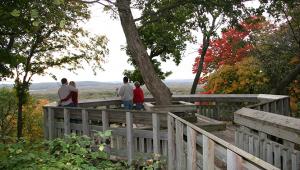
viewing platform of Missouri River floodplain. Includes
day-use area amenities at trail head.
Contact Station and Collections
Depository
Convert existing visitor center into a contact point and
artifact collections management center for site specific
material.
Campground, Service Area and Park
Residence
Will remain in current locations.
ACQUISITIONS
Acquisition of 47 Acres - Utz Site
(Acquisition #1)
Transfer back to the state park 47 acres that had been ceded
to the University of Missouri, Columbia in 1961 (Utz site) to
provide needed resource protection for underground artifacts
and features and to provide public interpretation on
site.
Acquisition of 835 Acres that contain and
surround the Utz Site (Acquisition #2)
Acquire 690 acres adjacent to the University of Missouri,
Columbia tract in order to protect this resource and to
provide access from proposed cultural center on mound field.
This National Historic Landmark - the Utz site - is currently
on the list of 'Threatened National Historic Landmarks' due
to incompatible uses, construction, looting and vandalism and
is considered in imminent danger of a severe loss of
integrity.
Acquisition of 88 Acres to the South of the
Park (Acquisition #3)
Acquire 88 acres to the south of the park to reduce soil
erosion and runoff into the Oumessourit Natural Area.
Acquisition of 322 acres to the South of the
Oumessourit Natural Area (Acquisition #4)
Acquire 322 acres of marsh and wetland bottomland forest to
protect and interpret this high quality wetland as a Missouri
Natural Area and to provide resource protection for known and
unknown archaeological resources in this area.
Acquisition of 256 acres to the North of the
Park (Acquisition #5)
Acquire 256 acres in order to provide resource protection
for known and unknown archaeological resources in this area
and to establish the northern and western boundary line along
an existing roadway.
Special Note Regarding Acquisitions/Purchase
Units
Acquisitions will be pursued through willing sellers.
PLANNING AND RESEARCH GOALS
Research and Archaeology
Research and archaeology will be an ongoing activity at the
site; especially as it relates to development projects
proposed in this plan and enhances interpretive efforts and a
basic understanding of the site.
Interpretive Plan
The Interpretive Plan will be completed to address all
interpretive issues at the site.
Cultural Resources Plan
The Cultural Resources Plan will be completed to address all
cultural resources of the site.
Natural Resources Plan
The Natural Resources Plan will be completed to address all
natural resources of the site.
Development Phasing
Development Phasing will be completed after the plan is
approved.
|
|
APPROVED BY:
| (Douglas K. Eiken) | Date: 01/29/02 |
| Director, Division of State Parks (Deborah Schnack) |
Date: 01/28/02 |
| Director, Planning and Development Program (Jim Rehard) |
Date: 01/24/02 |
| District Supervisor, Northern Missouri Historic
District (Connie J. Winfrey) |
Date: 01/18/02 |
Facility Manager, Van Meter State Park
APPENDIX
Members of the CDP Team
Mary Donze, Planner, Planning and Development
Program
Richard Forry, Assistant District Supervisor, Northern
Missouri Historic District
Lisa Goorjian, Planner, Planning and Development
Program
Larry Grantham, Archaeologist, Cultural Resource Management
Program
Wallace Keck, District Interpreter, Missouri River
District
Ken McCarty, Natural Resource Manager, Operations and
Resource Management Program
Jim Rehard, District Supervisor, Northern Missouri Historic
District
Connie Winfrey, Facility Manager, Van Meter State Park
Note: Wesley Johnson, former park superintendent at Van
Meter State Park, participated on the CDP team from January
1999 through April 2000.