






Trails
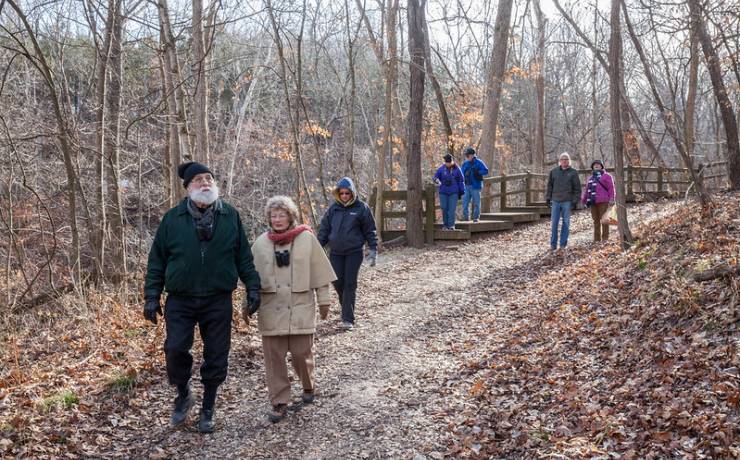
The Trail Condition Hotline, 573-442-2249, allows you to know before you leave home whether the trails are open or closed to bicycling or horseback riding.
Devil’s Icebox Trail - 0.5 mile - hiking and interpretive
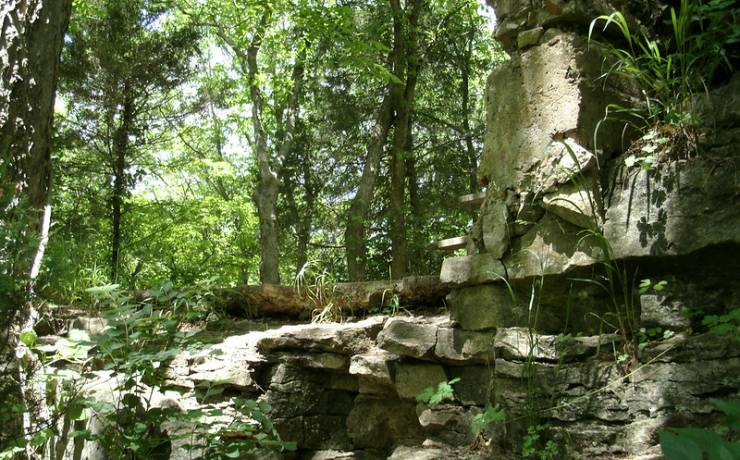
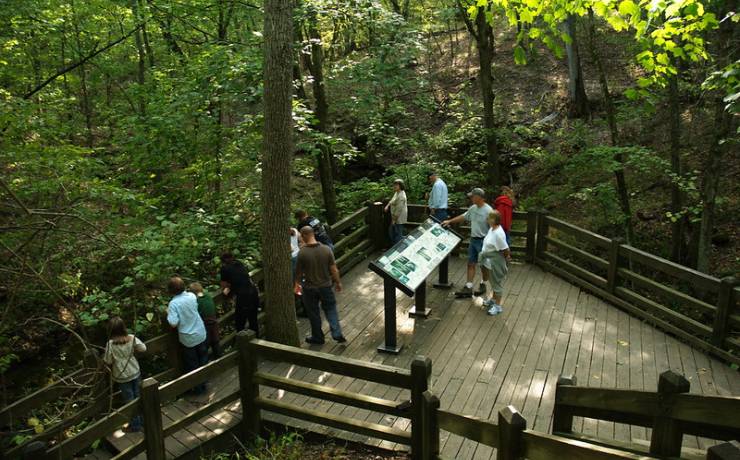
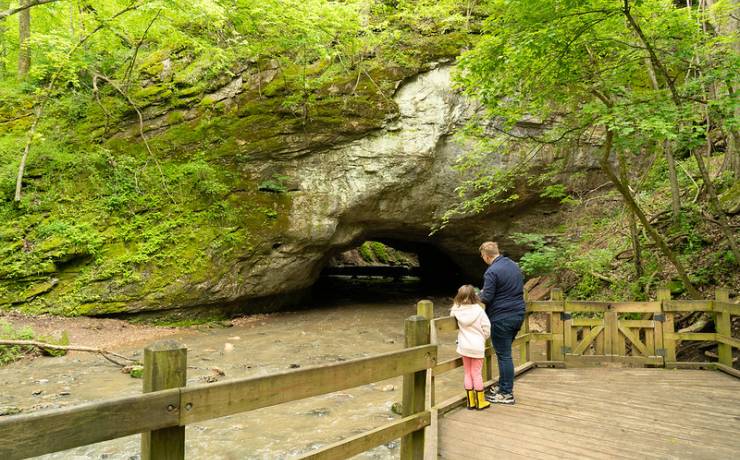
The park’s most impressive geologic features are revealed on this short walk that begins from the Devil’s Icebox parking lot. A boardwalk trail makes it easier to climb the 63-foot-tall Rock Bridge and eventually loops around to bring you back through the natural tunnel. To protect the resource, please stay on the trail. Features visible along the way include the valley that formed when the cave roof collapsed to form the Rock Bridge, a glade in the process of being restored, and the double sinkhole entrance to Devil’s Icebox Cave and Connor Spring.
The walk down the stairs to the cave entrance is refreshingly cool in summer months. Enough light enters the karst window to allow a short wade in the underground stream. Flashlights, helmets and good shoes are recommended for those brave enough to enter the darkness of Connor’s Cave, which lies downstream or to the left of the entrance to Devil's Icebox Cave. Devil’s Icebox Cave begins to the right or upstream from the cave entrance. Only those on park-led wild cave tours are permitted to enter Devil’s Icebox Cave.
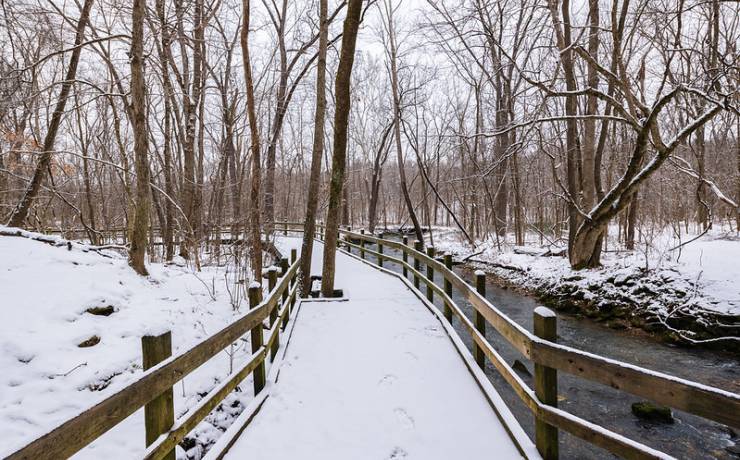
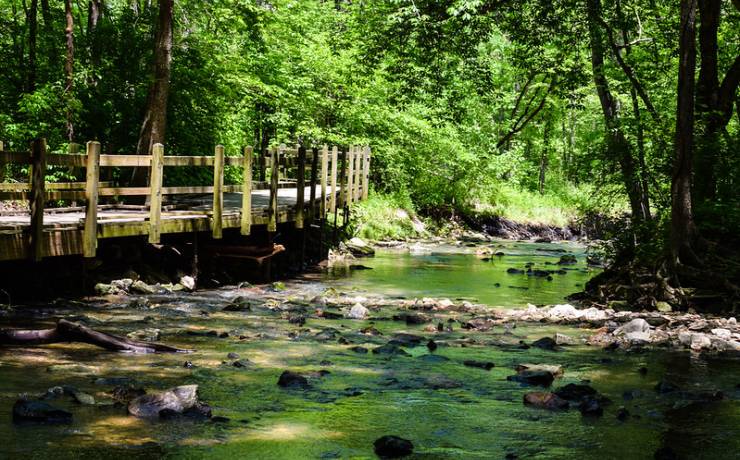
From the caves, the boardwalk meanders through the woods and keeps visitors’ feet dry inches above the stream that flows through the Rock Bridge. Displays tell visitors more about the cave system and the area’s history. Additional information can be gained from using the Devil’s Icebox Self-Guiding Trail booklet, which is available for a small fee at the park office.
Spring Brook Trail - 2.5 miles
- hiking and mountain biking
This is a loop trail that begins from the picnic shelter and
Devil’s Icebox parking lots. The eastern side of the
loop provides the shortest route (about 1.25 miles) between
the two parking areas. Spring Brook Trail winds its way
through woods and old fields and along small brooks. Maple
and sycamore trees grace the banks of Little Bonne Femme
Creek, which is crossed twice. At the eastern crossing, a
foot bridge provides a dry crossing and a nice view. The
western crossing lacks a bridge. During normal water flow, a
wade of a few inches depth is usually necessary or sometimes
dry stepping stones are in place. During high water, it is
not safe to cross. Spring Brook Trail is signed with red
arrows.
Sinkhole Trail - 1.5 miles
- hiking and mountain biking
Sinkhole Trail begins at the Devil’s Icebox parking
lot and follows an old road through the historic site of
Pierpont and continues up a forested valley to a ridge top of
old fields that is dotted with sinkholes. A spur connects
with the Grassland Trail parking lot, while a connector route
shortens the loop. The base of one sinkhole is gated to
prevent someone from falling into a 30-foot-deep pit known as
Hog’s Graveyard Cave. Sinkhole Trail is signed with
green arrows.
High Ridge Trail - 2.3 miles - hiking and mountain biking
The trailhead and parking for High Ridge Trail is located
on Rock Quarry Road near its intersection with Highway 163.
This trail climbs to a hilltop and follows a ridge before
descending to follow Clear Creek. Surrounding park lands can
be seen clearly from the ridge. High Ridge Trail is signed
with blue arrows. The use of a white connector trail reduces
the distance to half a mile.
Grassland Trail - 2 miles
- hiking and mountain biking
The trailhead and parking lot for Grassland Trail is
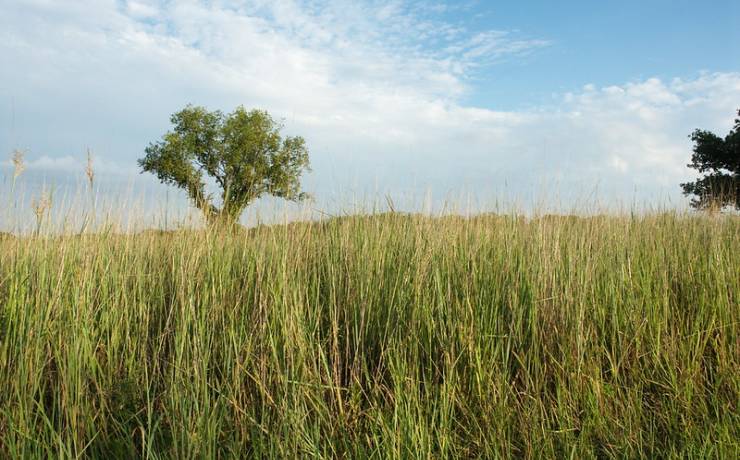
located on Rock Bridge Lane. Native grasses, planted
beginning in 1982, clothe the gentle terrain that is marked
with scattered wooded sinkholes. Natural sinkhole ponds
provide habitat for wetland plants and animals such as
salamanders, wood ducks and bur reed. The trail is signed
with blue arrows and has a white connector that cuts the loop
in half.
Karst Trail - 1.75 miles
- hiking and mountain biking
Karst Trail begins near the intersection of Highway 163 and
Fox Lane. The land is relatively flat with many scattered
sinkhole depressions. Devil’s Icebox Cave is located
nearby--only about 100 feet underground! On the eastern side,
a large pond is filled with American lotus, which blooms
around mid-July. A barn from the Ginn family farm still
stands. The area has a three-acre remnant stand of big
bluestem grass. Additional acreage was planted in native
grass in 1995. Karst Trail is signed with red arrows and has
a short white connector that cuts the loop in half.
Deer Run Trail - 2.5 miles
- hiking and mountain biking
Deer Run Trail begins from the northern picnic areas. The
trail traverses up and down wooded hills along the
park’s northwestern boundary. Then it descends to the
flat bottomlands and runs along the banks of the Little Bonne
Femme Creek, where it intersects Spring Brook Trail before
looping back to its starting point. Deer are common in the
area due to secluded woods and grassy openings. Signs of
beavers and muskrats are sometimes seen along the stream. The
loud calls of pileated woodpeckers and kingfishers are
sometimes heard in the stream vicinity. Deer Run Trail is
signed with yellow arrows.
Paxton Passage - 0.5 mile
- hiking and mountain biking
Paxton Passage begins at its intersection with Deer Run
Trail near the northwestern boundary of the park. Paxton
Passage leaves park property and travels on a strip of land
donated by Richard Paxton to the Columbia School District in
1979. It connects to and can be accessed from the grounds of
Rock Bridge Elementary School.