








[Skip all navigation]

DNR Home PageDNR Home Page | Locator Map | Resource Center | FAQ |Events | Directory | Search

The Ozark Trail
800-334-6946

Welcome to the Ozark Trail

Welcome to the Ozark Trail.

Trails have laced the earth’s surface for countless centuries. Early human beings followed game trails, and eventually wore trails of their own as they migrated and searched for food and water. Later, trails were developed between villages to allow for increased trade and cultural interchange. Trails also, of course, led to areas of special beauty and areas having spiritual significance.

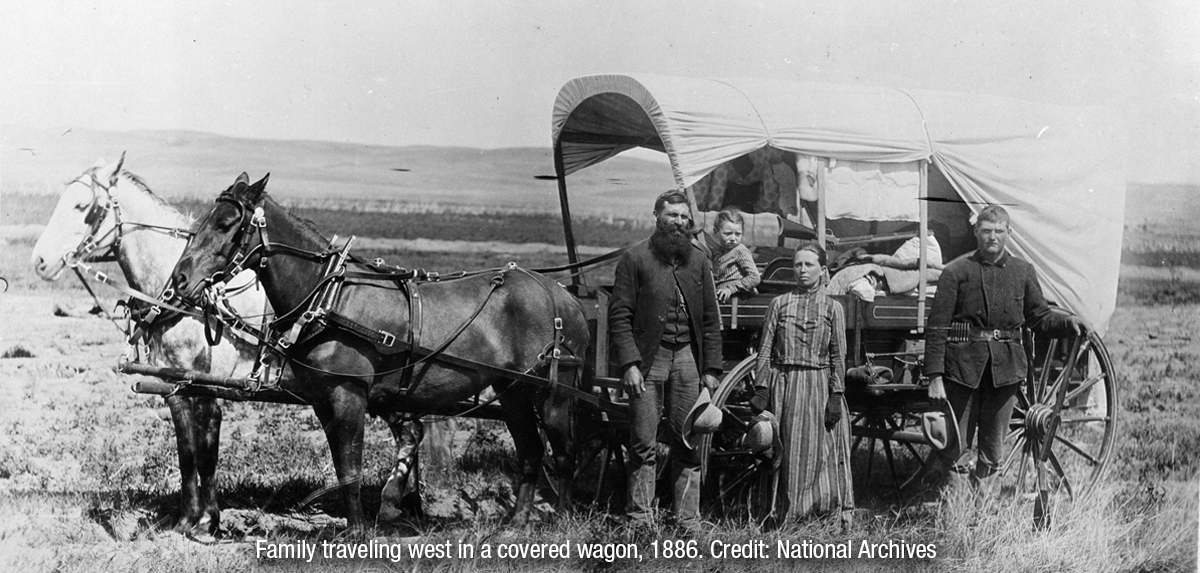
Trails such as the Independence, the Oregon, and the Santa Fe, on which settlers moved westward across America, are legendary. Most of these trails, however, fell into disuse as roads and then paved highways lured people to speedier forms of locomotion. For many people, speed has lost at least some of its appeal and non-motorized travel again has gained importance.

Modern-day travelers are not settling new frontiers; instead, they usually seek quiet contrast to their often-hectic lives. They explore autumn-colored hills, rushing spring-fed rivers and quiet hollows. They find revitalization, inspiration and adventure in meeting the natural world on its own terms; sometimes, too, they relive at least a little of the original pioneer experience.

All of these scenic features and wilderness qualities that trail enthusiasts seek can be found in the Ozarks. These natural attractions, coupled with the sizable amount of public-owned property in the Ozarks, have prompted many trail users and land-managing agencies to envision a trail that would someday traverse the Ozarks extending from St. Louis through western Arkansas. Now, through a unique cooperative effort between state and federal agencies, private landowners and trail users, this vision of a 500-mile trail across the Missouri Ozarks is becoming a reality.

HOW WAS THE OZARK TRAIL ESTABLISHED
AND WHO IS RESPONSIBLE FOR ITS ADMINISTRATION?

In 1977, a group of public land managers, trail users and private landowners met to discuss the concept of a long-distance trail that would traverse the Missouri Ozarks. The concept was met with great enthusiasm and resulted in a commitment to work toward the development of such a trail and to establish the Ozark Trail Council. As plans for the Ozark Trail in Missouri were being formulated, a similar movement was taking place in Arkansas. The result was a commitment to develop a trail through Rocky Falls, accessed via the Current River Section.the Ozarks of northwest Arkansas to be known as the Ozark Highlands Trail. The goal of both states is now to connect the Ozark Trail and the Ozark Highlands Trail, which will provide the opportunity to travel more than 800 miles through some of the most scenic country in the Midwest.

WHERE IS THE OZARK TRAIL LOCATED
AND WHEN WILL IT BE COMPLETE?

The Ozark Trail follows a scenic and varied route from the St. Louis metropolitan area southwestward through the Ozarks of southern Missouri to the Arkansas border where it will join the Ozark Highlands Trail. It also includes an eastern loop that traverses the scenic St. Francois Mountains region. Although much of the trail development to this point has taken place on public land, future development will be dependent upon the ability to negotiate trail easements with private landowners. The Ozark Trail is now more than 25 years old and it is hoped that the entire Ozark Trail will be complete in 10-15 years. The map in this brochure shows more than 300 miles of completed trail, as well as the entire proposed route.

WHAT IS THE PURPOSE OF THE OZARK TRAIL COUNCIL
AND WHO ARE ITS MEMBERS?

The purpose of the Ozark Trail Council is to promote the Ozark Trail; to establish guidelines for its construction, maintenance, marking and mapping; to publicize the trail; and generally to provide an organizational framework within which all matters relating to the Ozark Trail in Missouri can be discussed and resolved.

Landowners, land managers and trail users are all represented on the council. Key members include: Mark Twain National Forest, Ozark National Scenic Riverways, U.S. Army Corps of Engineers, Missouri Department of Conservation, Missouri Department of Natural Resources, Pioneer Forest, Sierra Club, Ozark Trail Association, Hostelling International, the Conservation Federation of Missouri, Show-Me Missouri Back Country Horsemen and Meramec Greenway..

Greer Spring, accessed via the Eleven Point River Section, Mark Twain National Forest.

DOES THE OZARK TRAIL CROSS PRIVATE LAND?

Much of the Ozark Trail is located on state and federal land, but some sections cross private property. Crossings occur only where voluntary consent of the landowner has been obtained. Landowners retain all rights of ownership to their property and grant use for trail purposes only and not for public access to their land for such activities as hunting, fishing and camping. Such use may be terminated at any time by the landowner. Thus, it is especially important that trail users respect the private landowner’s land and right to privacy. Close all gates; stay on the path; and stay away from cattle, timber and mining operations, homes, etc. All risk and responsibility when crossing private land is that of the trail user, not that of the landowner.

WHO BUILDS AND MAINTAINS THE OZARK TRAIL?
HOW CAN I HELP?

The land manager whose land the trail traverses is responsible for constructing and maintaining the trail. In the case of private property, the agency or organization having the trail easement holds these responsibilities. Those responsible for these tasks often seek the assistance of volunteers to help construct the trail and then assume some of the maintenance duties. In 1998, the Ozark Trail Team concept was formed by the Conservation Federation of Missouri to recruit and train volunteers and to promote the Ozark Trail. Since then, the Department of Natural Resources’ Division of State Parks and the Ozark Trail Association have adopted the Trail Team concept.

Equestrian use on sections of the Ozark Trail.As a trail user, it is important that you share your knowledge of the trail with other potential users. As a member of a user organization, you can assist by taking construction or maintenance responsibility for a portion of the trail. As a property owner, you can share your land with others who seek only to enjoy its scenic and primitive qualities by allowing the Ozark Trail to cross your property. If you would like more information about volunteering to help with scheduled maintenance outings and training, please check with the Ozark Trail Association, P.O. Box 1431, Steelville, MO 65565 or visit its website at www.ozarktrail.com. The Ozark Trail Association is a grassroots non-profit volunteer group that has been dedicated to the construction, maintenance and promotion of the Ozark Trail since December 2002.

For general comments or questions about the trail, and to obtain section maps, contact the Missouri Department of Natural Resources, Ozark Trail Coordinator, P.O. Box 176, Jefferson City, MO 65102-0176 or by calling 800-334-6946.


WHO MAY USE THE TRAIL?

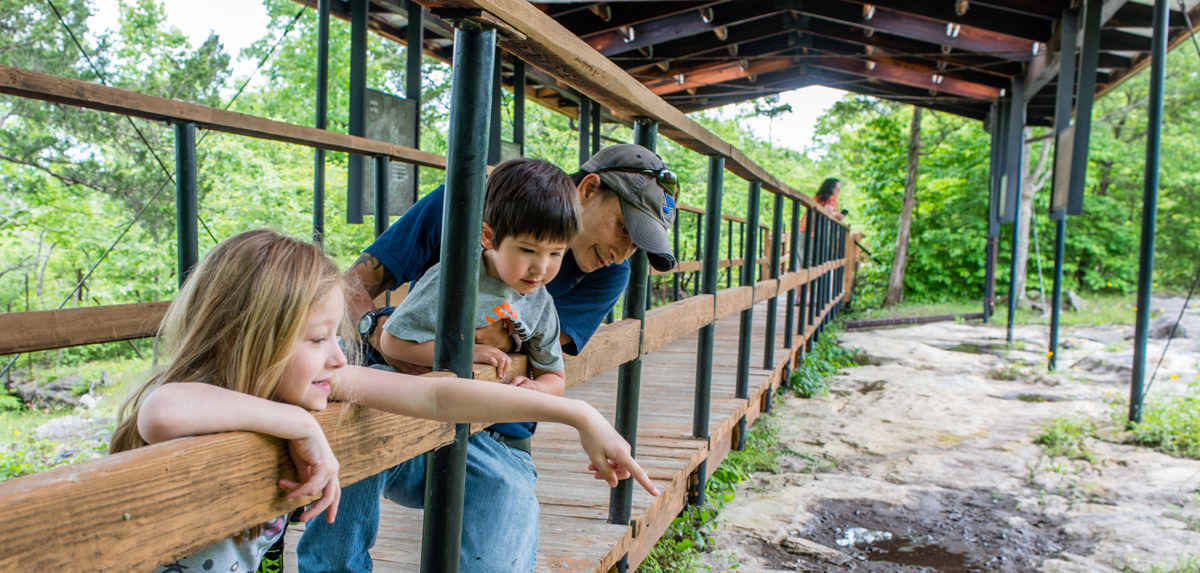
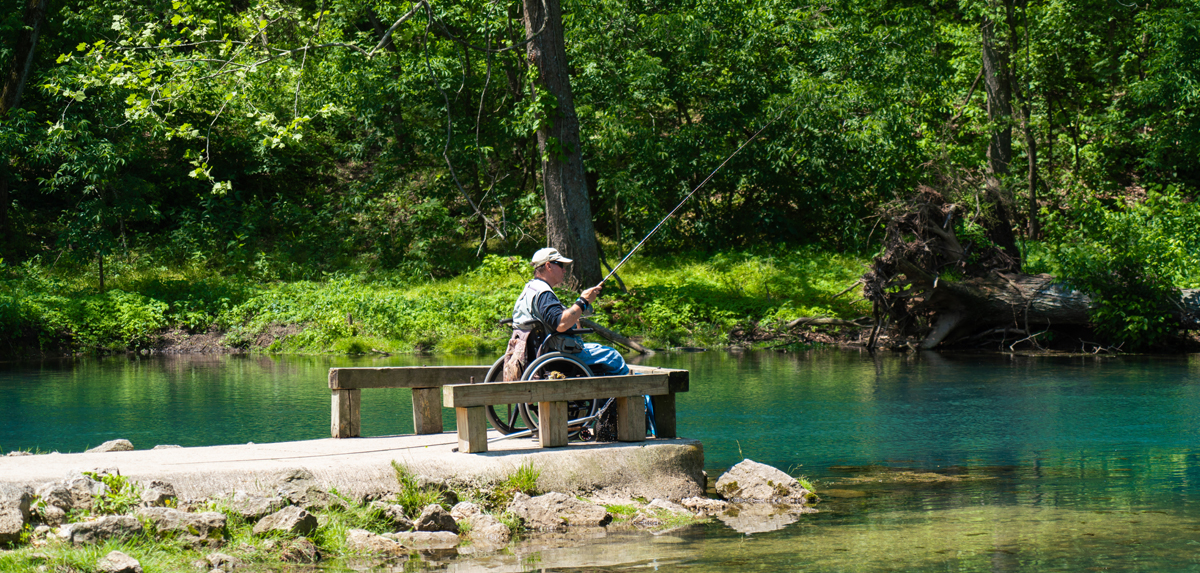
The Ozark Trail is for families, groups, individuals and for the old and young alike. It can be traveled for an hour with no specialized equipment, or for days with sophisticated gear.

The Ozark Trail is being built to provide a high quality outdoor experience. Motorized vehicles are not permitted on any section of the Ozark Trail.

WHEN IS IT BEST TO USE THE TRAIL?
DO I NEED SPECIAL SKILLS OR EQUIPMENT?

All seasons offer their charms - and challenges. Be prepared with rain gear, appropriate clothing and footwear, food, a first Ozark Trail sign; photo by Bruce Linders.aid kit and the company of others. Carry a map, compass and water. Using caution and good judgement will ensure an enjoyable experience. Short trips can be enjoyable no matter what your physical condition; long trips may require some special conditioning. Be prepared in the case of an emergency, and do not rely on cellular phone service, which is not available on most of the Ozark Trail.

HOW IS THE TRAIL MARKED?

Signing is kept to a minimum to allow you the pleasure of uninterrupted natural surroundings. In confusing areas or for an occasional reminder, a green OT on a white rectangle is used. In designated wilderness areas of the Mark Twain National Forest, no trail signage will be used - hatch marks on trees will indicate the trail when necessary.

BE TRAIL WISE

Low impact use of the Ozark Trail and backcountry is one way you can show that you care for both the natural environment and other visitors who follow. In order for you to be “trail wise” concerning low impact use of the Ozark Trail and backcountry, follow these trail recommendations:

THE SECTIONS STORY

Ozark Trail overview map.Missouri's Ozark Trail is divided into sections of trail roughly between 20 and 30 miles in length. Each section has been named for a natural or historical feature of the area. The one exception is the Karkaghne Section. Although the origins of this word are unknown, stories abound of a mythical forest creature. The northernmost sections of the Ozark Trail, incomplete at this time, will eventually become a part of the Meramec Greenway, a 108-mile corridor connecting the St. Louis metropolitan area to the rural and backcountry areas for which the Ozark Trail is best known. Shuttle services vary, but local canoe liveries may give you a lift.


Link to additional location and trail information for the North Fork River Section. Link to additional location and trail information for the Eleven Point River Section. Link to additional location and trail information for the Between the Rivers Section. Link to additional location and trail information for the Current River Section. Link to additional location and trail information for the Blair Creek Section. Link to additional location and trail information for the Karkaghne Section. Link to additional location and trail information for the Middle Fork Section. Link to additional location and trail information for the Courtois Creek Section. Link to additional location and trail information for the Trace Creek Section. Link to additional location and trail information for the Taum Sauk Section. Link to additional location and trail information for the Marble Creek Section. Link to additional location information for the St. Francois River Section. Link to additional location and trail information for the Wappapello Lake Section. Link to additional location and trail information for the Victory Section. Link to additional location information for the Meramec River Section.